It ranks among the questions we hear most from trades across Dorset: “Do Google reviews actually help my ranking, or do they just look nice?”
The short answer is yes. Reviews affect where you show up on Google Maps and in local search, and Google says so itself.
The longer answer is more useful, though. Not all reviews help equally, and a big number on its own does not guarantee a top spot. Here is how reviews really influence your rankings, and what that means for how you collect them.
What Google Says About Reviews
Google ranks local businesses on three main factors: relevance, distance and prominence. Reviews feed directly into prominence, which means how well known and trusted your business looks.
In its own help pages, Google says that review count and review score factor into local search ranking, and that more reviews and positive ratings can help your ranking. That is about as direct as Google ever gets about its rankings.
So reviews matter. The real question is which parts of them matter.
The Review Signals That Count
How many Google reviews you have
Volume shows Google that plenty of real customers use your business. A roofer with 120 reviews looks far more established than one with 8. Compare your total against the businesses currently sitting in the top three for your trade and town. That is your benchmark.
How recent they are
A pile of reviews from 2021 and nothing since tells Google, and customers, that things may have gone quiet. A steady flow of fresh reviews shows an active, busy business. Two reviews a week beat 40 in one month followed by silence.
Your average star rating
A higher rating helps, but you do not need a perfect 5.0. Customers often trust a 4.7 with a few honest, well-handled negatives more than a flawless score. What hurts is a pattern of poor reviews with no replies.
What customers actually write
The words inside reviews carry weight. When customers mention the job and the place, such as “new boiler fitted in Christchurch” or “fixed our leaking roof in Poole”, they help show Google what you do and where you do it.
You cannot tell customers what to write. You can ask them to mention the job they had done, which most will happily do.
Whether you reply
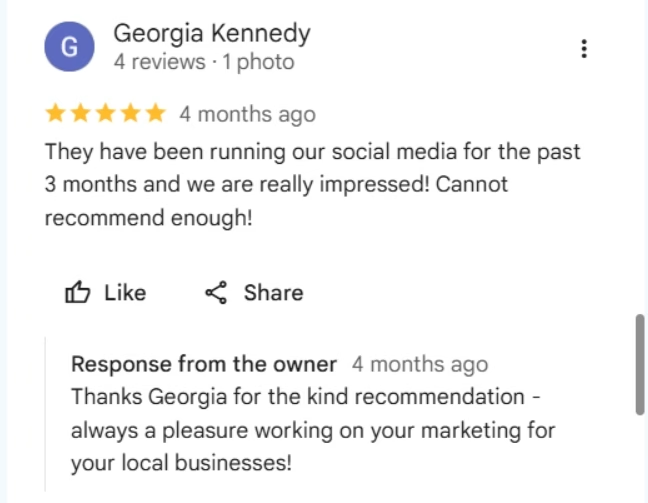
Google encourages businesses to respond to reviews, and replying shows an active, engaged business. It also helps convert the customers who read them.
Reviews Win the Click Too
Ranking only gets you seen. Reviews also decide whether customers choose you once they see you.
Picture the Map Pack for “electrician Bournemouth”. Three businesses, side by side. One shows 4.9 stars from 140 reviews. Another shows 4.3 from 11. Which one do you ring?
That choice matters for rankings as well as calls. Customers who click, call and ask for directions all show Google that searchers find your business useful. Strong reviews turn visibility into actual work.
What Reviews Cannot Do on Their Own
Here is the honest bit. Reviews are powerful, but they do not work in isolation.
A plumber with 300 reviews can still miss the Map Pack if the profile uses the wrong category, the website says nothing about the towns covered, or the business name, address and phone number vary across the web. Distance still matters too. Great reviews will not make a Poole business rank first for searches in Dorchester.
Think of reviews as the fuel. Your profile, website and citations make up the engine. You need both. Our step-by-step guide to ranking in the Google Map Pack shows how everything fits together.
Do Reviews on Other Sites Count?
Reviews on Facebook, Checkatrade, Trustpilot and Yell help build trust with customers, and they add to the wider picture of your business online. AI search tools such as ChatGPT also read reviews from across the web when they recommend local businesses, as we explain in how AI search affects local businesses.
For ranking on Google Maps specifically, though, Google reviews do the heavy lifting. If you only have time to focus on one platform, make it Google.
So What Should You Do?
Keep it simple:
- Ask every happy customer for a Google review, on the day, with a direct link
- Aim for a steady flow every week rather than occasional bursts
- Ask customers to mention the job they had done
- Reply to every review, good and bad
- Never buy reviews or offer incentives
Our guide to getting more Google reviews gives you 15 practical tactics to put this into action.
Want a Review System That Runs Itself?
Most trades know reviews matter. Very few have a system that brings them in consistently while they get on with the work.
At JNB Marketing, we set up review strategies for trades and service businesses across Bournemouth, Poole and Dorset. We create your links and QR codes, write your request messages and reply to your reviews, all as part of our marketing support packages.
Get in touch and we will show you exactly how your reviews compare with the businesses ranking above you.
Google Reviews and SEO FAQ
Do more Google reviews mean higher rankings?
Generally, yes, but not on their own. Google says more reviews and positive ratings can help your ranking. Your category, website, citations and distance from the searcher all still play a part.
Do negative reviews hurt my ranking?
A few negatives will not sink you, especially with calm, professional replies. A steady pattern of poor reviews does hurt, both in rankings and in the number of customers who choose you.
Does replying to reviews help SEO?
Replying shows Google an active business and helps convert customers reading your profile. Google encourages it, so reply to every review.
How quickly do new reviews affect my ranking?
There is no fixed timescale. Reviews build up over time, so a steady flow over months does far more than a sudden burst. Treat reviews as a habit, not a one-off campaign.