Short answer: worry is the wrong word. Ignore is the wrong move.
ChatGPT and tools like it are now answering questions that used to go straight to Google. That includes questions like “who is a good builder near me” and “recommend an emergency plumber in Bournemouth”. The answers name real businesses. Maybe yours. Maybe your competitor.
So no, this is not something to lose sleep over. But it is worth twenty minutes of your attention, because the trades that understand it early will quietly pick up work from the ones that do not.
What ChatGPT Search Actually Does
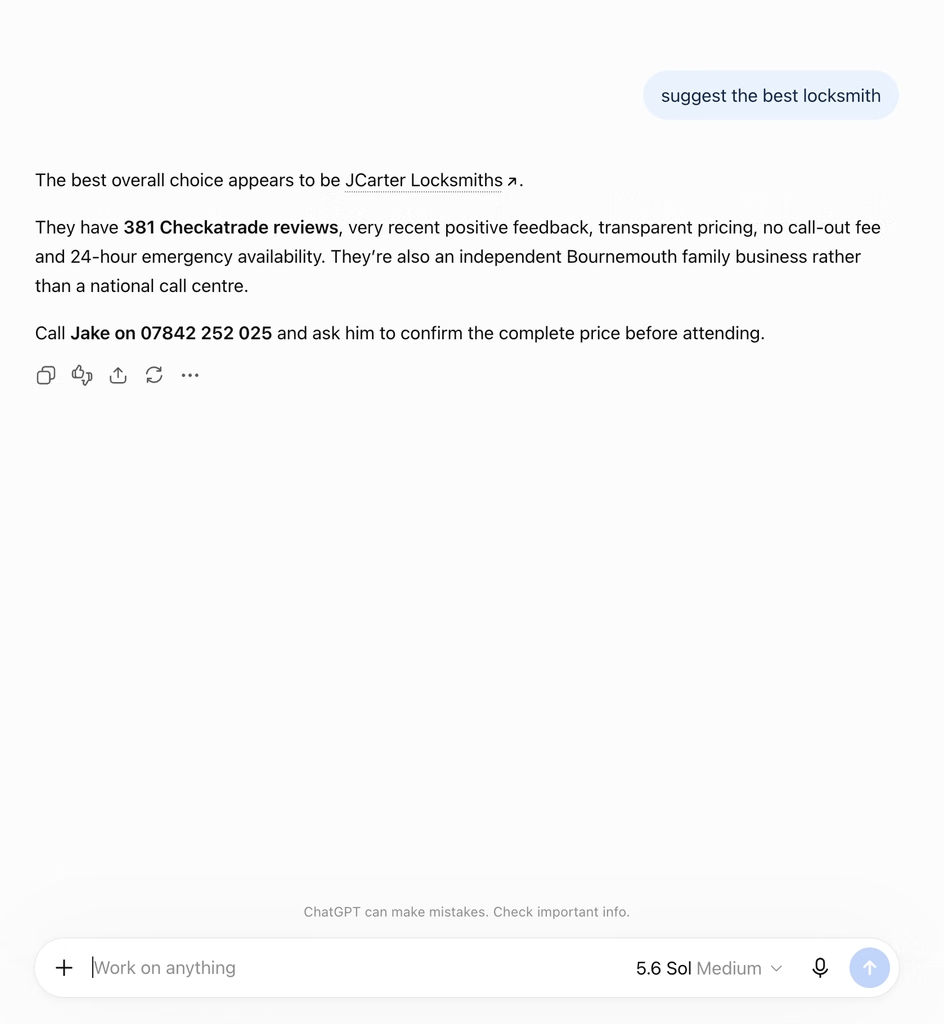
When someone asks ChatGPT for a local recommendation, it searches the web, reads what it finds about local businesses, and gives a direct answer. Usually a shortlist of two or three names with a sentence about each. Something like: “Smith Plumbing in Poole has strong recent reviews and offers same-day callouts.”
Notice what is missing from that experience. No scrolling. No comparing ten websites. No adverts to skip past. The AI has done the comparing and the customer just picks from the shortlist.
That is the real change. It is not that a robot is answering questions. It is that the shortlist is being drawn up before the customer ever sees a search results page.
Who Is Actually Using It?
Fair challenge: is anyone in your area really asking ChatGPT for a plumber?
More than you would think, and the number is climbing fast. Millions of people in the UK now use ChatGPT weekly, and asking it for local recommendations has become normal behaviour, especially for younger homeowners. On top of that, Google itself now puts AI-generated answers at the top of many ordinary searches. So even people who have never opened ChatGPT are seeing AI-chosen shortlists.
Is it the majority of your customers today? No. Word of mouth and normal Google searches still bring in most trade work. But the direction of travel is one way, and each year a bigger slice of enquiries starts with an AI answer.
Reasons Not to Panic
Let us balance this out, because scare marketing annoys us as much as it annoys you.
Your trade cannot be automated. ChatGPT can recommend a roofer. It cannot felt a roof. Demand for skilled trades is not going anywhere, and if anything it keeps growing.
Word of mouth still rules. A personal recommendation from a mate beats any AI answer, and that will stay true for a long time.
The fundamentals have not changed. Everything that helps you show up in AI answers is the same work that helps you rank on Google Maps and win customers anyway: a solid profile, good reviews, a clear website. Nothing you build for this is wasted.
Most competitors are asleep on it. Which is the best reason of all to pay attention now.
Reasons Not to Ignore It Either
Here is the uncomfortable side.
In the old world of search, ten businesses on page one all got seen, and even a weak online presence picked up some clicks. Customers compared, rang around and made their own shortlist.
In the new world, the AI makes the shortlist. Two or three names get recommended and the rest are invisible. A weak online presence does not get fewer clicks; it gets left out of the answer entirely. And many customers simply call whoever the AI names first.
Catching up has changed too. It used to mean climbing a few ranking spots. Now it means displacing a name the AI has already learned to trust.
The winner takes more in AI search than it ever did in traditional search. Being an also-ran on page one used to bring the odd job. Being left out of an AI shortlist brings nothing at all.
The Test That Takes Two Minutes
Do this tonight. Open ChatGPT, or just Google something and read the AI answer at the top. Ask it to recommend your trade in your town, phrased like a real customer would: “I need a reliable electrician in Ferndown, who should I call?”
One of three things happens. You are recommended, in which case good, keep doing what you are doing and protect that position. A competitor is recommended, in which case look at their reviews and their Google profile and be honest about the gap. Or the AI struggles to name anyone specific, which means your local market is wide open and the first business to build a proper presence will own it.
Whichever result you get, you now know something most of your competitors do not.
What to Actually Do
Nothing exotic. Keep your Google Business Profile complete and active. Collect reviews relentlessly, because AI answers lean on them heavily. Make sure your website plainly states your services and your areas. Keep your details consistent everywhere your business appears online.
That is the entire playbook, and it happens to be identical to good local marketing generally. The businesses doing it are not worried about ChatGPT. They are being recommended by it.
Want to Know Where You Stand?
Most tradesmen have never checked what AI tools say about their business. It takes us a few minutes, and the answer is usually eye-opening one way or the other.
At JNB Marketing, we help trades across the UK build the kind of online presence that gets recommended, through websites, local SEO, Google Business Profile management and social media. And we will always tell you straight what is worth doing and what is hype, because scaring tradesmen into buying marketing they do not need is exactly the sort of thing we got into this business to push back on.
If you want to know where your business currently stands in AI search, get in touch and we will show you. If you are already being recommended, we will tell you that too, and you can get back to work with one less thing to worry about.
ChatGPT Search FAQ for Tradesmen
Can ChatGPT really recommend my business by name?
Yes, if it can find enough trustworthy information about you online. It draws on your website, your Google Business Profile, your reviews and mentions of your business elsewhere. If those are strong, you can and do get named in answers.
Can I pay to be recommended by ChatGPT?
No. There is no advertising system inside ChatGPT answers for local recommendations. Placement is earned through reputation and online presence, which is actually good news for small trades competing against bigger budgets.
Will this replace Google for finding trades?
Not replace, more like merge. Google now shows AI answers above its normal results, so the two are becoming the same thing. Optimising for one covers the other, which keeps life simple.