GEO & LLM SEO for Trades and Local Service Businesses
If you run a plumbing, electrical, building, drainage, damp proofing or locksmith business, getting found online is no longer just about ranking in the old-fashioned blue links. People are increasingly searching in more conversational ways, and search platforms are increasingly summarising answers before the click. That means your business needs to be easy to understand, easy to trust, and easy for search engines and answer engines to cite.
The good news is that you do not need a gimmick-heavy “AI hack” strategy. Google says the same core SEO best practices still matter for AI Overviews and AI Mode, and pages only need to be indexed and eligible to appear in Search with a snippet. In plain English, if your site is technically sound, locally relevant, genuinely useful, and full of real-world proof, you are already working in the right direction.
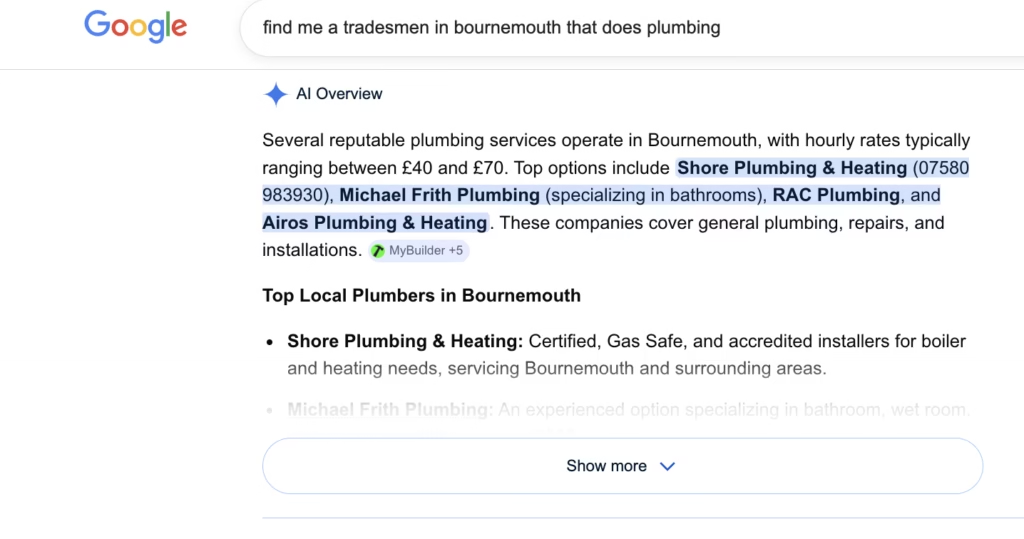
What GEO and LLM SEO actually mean
Traditional SEO is about helping your pages rank in search results.
GEO and LLM SEO are about helping your business and your pages become good sources for AI-generated answers as well.
The difference matters because answer engines often summarise multiple sources instead of sending every user to a single page.
The original GEO research also found that structured, authoritative, citation-friendly presentation can improve visibility in generative responses, though the effect varies by domain.
| Focus area | Traditional SEO | GEO / LLM SEO |
|---|---|---|
| Main goal | Rank pages for relevant searches | Become a trusted source that gets cited, summarised, or recommended |
| Typical user behavior | Clicks through search results | Reads an overview, asks follow-up questions, may click only after trust is established |
| What matters most | Relevance, technical SEO, links, local signals | All of the SEO basics, plus answer clarity, extractable structure, entity consistency, and proof |
| Best content style | Helpful, targeted, well-optimised pages | Helpful, targeted, well-optimised pages that answer questions cleanly and credibly |
For trades businesses, this means your content should explain exactly what you do, where you do it, what jobs you handle, what makes you trustworthy, and why someone should contact you rather than keep searching.
How trades businesses get mentioned in search and AI answers
When local customers search, Google’s local systems mainly look at relevance, distance, and prominence.
- Relevance improves when your profile and website clearly describe your real services.
- Distance is about where the searcher is relative to the area you serve.
- Prominence is influenced by signals such as reviews and links. Google also explicitly recommends complete business information, verification, current hours, review responses, and photos/videos.
For service-based trades, this is especially important because many businesses are service-area businesses rather than storefront brands.
Google defines a “service-area business” as one that visits customers directly and does not serve customers at its own address, and its help documentation allows up to 20 service areas to be set in the profile. If that is your setup, your website copy and Business Profile should describe those service areas consistently and precisely.
The practical takeaway is straightforward:
If you want to be surfaced in Google and in AI answers, your website and your profile need to tell the same clear story.
That story should cover your main services, the places you serve, the proof behind your work, and the reasons customers trust you.
What your website should include?
Your site should not be a handful of generic pages with a phone number in the footer.
It should be a proper local authority asset, with clear service pages, supporting location content, FAQs, project proof, trust pages, and internal links that help both users and crawlers move logically through the site. JNB’s own public content already points in this direction by highlighting local citations, off-site SEO, backlinks, reviews, directories, local PR, page speed, internal linking, URL structure, sitemap, HTTPS, and schema markup.
| Page type | What to include | Why it helps |
|---|---|---|
| Homepage | Who you are, core services, primary locations, trust signals, strong CTA | Gives a clear top-level entity summary |
| Service pages | One page per main service with process, common faults, proof, FAQs, and CTA | Matches job-specific searches and answer-engine queries |
| Location pages | Only for places you genuinely serve; include local proof, real examples, testimonials, and unique FAQs | Improves local relevance without creating doorway-style thin pages |
| Project / case study pages | Before-and-after images, scope of work, area served, timeline, and customer outcome | Adds originality, proof, and internal-linking opportunities |
| About / trust pages | Credentials, guarantees, years of experience, team, vans, insurance, memberships | Supports credibility and conversion |
| FAQ pages | Direct answers to common pricing, timescale, emergency, and service-area questions | Good for snippet-style extraction and user reassurance |
A good rule is to create pages around real business categories and real jobs, NOT around every keyword variation you can think of.
One strong “Emergency Plumber” page is useful. Ten near-identical pages for “best emergency plumber,” “24 hour plumber,” and “plumber near me” in the same town usually are not.
Google says duplicate content is not itself a spam violation, but it does canonicalise similar pages, and large-scale unoriginal content can become spam if it is being produced mainly to manipulate rankings.
Use schema, but use it properly
Google says structured data helps it understand page content and general web entities, and Local Business structured data can feed business details such as hours and other attributes into richer search appearances.
For trades, that usually means using LocalBusiness or Organisation markup at the site level, Service markup where appropriate, and page-level markup that reflects the actual page type.
Specific schema types also exist for trade businesses such as electricians, plumbers, locksmiths, and general contractors.
Two cautions matter here.
First, Google’s FAQ rich results are now limited: the current documentation says FAQPage rich-result eligibility applies to government-focused or health-focused sites, so a trades company should still use clear FAQ content for users and answer extraction, but should not expect FAQ rich results as a likely outcome.
Second, Google no longer displays self-serving review-rich results for LocalBusiness and Organization pages, even if the stars come from a third-party widget embedded on your own site. So by all means show testimonials for trust, but do not build a strategy around star markup on your own business pages.
Build off-page trust that matches your trade
Trade-specific trust sources are one of the biggest opportunities to make this rewrite feel genuinely built for local services rather than adapted from accountants.
For example, gas firms can strengthen trust through Gas Safe Register, electricians through NICEIC, general builders through the Federation of Master Builders, damp proofing and property care specialists through the Property Care Association, drainage specialists through the National Association of Drainage Contractors, and broader home-improvement firms through TrustMark.
These are not magic bullets, but they are exactly the kind of real-world corroboration that makes a trade’s brand easier to verify online.
Simple action plan for the first month
The fastest wins usually come from cleaning up what already exists before producing lots of new content. Google’s local documentation strongly supports that sequence: accurate profile data, verification, hours, reviews, photos, and clear service descriptions first; then move into stronger site architecture and structured content.
| Timeframe | Priority | Tasks | Expected outcome |
|---|---|---|---|
| Week one | Highest | Audit Google Business Profile, categories, service areas, NAP consistency, existing service pages, indexation, internal links, and top local competitors | Clear baseline and fastest cleanup list |
| Week two | Highest | Rewrite homepage and main service pages, improve titles/H1s, add stronger CTAs, update hours, photos, FAQs, accreditations, and review prompts | Better relevance and stronger conversion |
| Week three | High | Build or improve key location pages, add case studies/project pages, implement schema, improve internal linking, simplify URL structure | Better local depth and better crawlability |
| Week four | High | Push review gathering, directory/citation cleanup, local PR outreach, supplier/manufacturer mention opportunities, and monitoring setup | Stronger prominence and more corroboration |
Common mistakes trades businesses should avoid
The first mistake is cloning city pages with only the town name changed. If each location page does not have unique local proof, unique FAQs, unique examples, and a genuine reason to exist, it is more likely to dilute quality than help. Google’s canonicalization and scaled-content guidance both point in that direction.
The second mistake is treating your website and your Business Profile like separate projects. They should reinforce each other. Your service areas, service descriptions, categories, contact details, and proof should tell the same story across both. Google explicitly asks businesses to keep their representation consistent and precise.
The third mistake is relying on filler articles that do not help customers make a decision. Google says AI-generated or AI-assisted content can be useful, but pages produced at scale without adding value can violate spam policies. If you use AI to speed up drafting, the final page still needs human judgment, local detail, and genuinely useful advice.
FAQ copy for featured snippets and AI-style answers
Do trades businesses need a different SEO strategy from national businesses?
Yes. Local trades businesses depend more heavily on service-area signals, reviews, categories, real-world trust, and location relevance than a purely national brand. Google’s local ranking guidance is built around relevance, distance, and prominence, so local clarity matters far more than broad, generic content.
What is GEO in simple terms?
GEO means making your content easier for AI-driven search experiences to understand, trust, summarize, and cite. It does not replace SEO. It sits on top of strong SEO, local signals, and useful content.
Do I need separate pages for every town I work in?
Not always. You should only create location pages where you can add real, unique value such as local case studies, service details, reviews, FAQs, and examples. Otherwise, one stronger regional page may be better than several thin pages.
Do reviews really help local visibility?
Yes. Google says prominence is influenced partly by reviews and web links, and that more reviews and positive ratings can help local ranking. Replying to reviews also helps show that you value customer feedback.
Should I add FAQ schema to my trades website?
Use FAQ content because it is useful for customers and answer extraction, but do not expect Google FAQ rich results as a likely outcome for a trades site. Google’s current FAQPage rich-result eligibility is limited to government-focused and health-focused sites.
Can I put review stars on my own homepage?
You can display testimonials for trust, but Google does not show self-serving review rich results for LocalBusiness and Organization pages, including cases where the reviews come through a third-party widget embedded on your own site.
Need help doing this properly?
If you want this handled in a practical, no-nonsense way, take a look at our SEO service, then book a call with us!
But if you have got this far, we have put together some actions for you today!
Action Plan and Priority Matrix
The logic of the rollout below follows the highest-confidence guidance from Google’s AI-search, local-search, structured-data, and page-experience documentation: fix core business/entity clarity first, then strengthen pages, then add corroboration and monitoring.
| Tactic | On-page or off-page | Impact | Effort | Suggested timing |
|---|---|---|---|---|
| Google Business Profile cleanup | On-page / entity | Very high | Low | Immediate |
| Rewrite core service pages | On-page | Very high | Medium | Immediate |
| Review generation and review replies | Off-page / reputation | Very high | Medium | Immediate and ongoing |
| Case studies / project pages | On-page | High | Medium | Early |
| Location pages with unique proof | On-page | High | Medium | Early |
| Schema for business, service, and articles | On-page / technical | Medium to high | Medium | Early |
| Citation cleanup and directory consistency | Off-page | Medium | Medium | Early |
| Trade-body / accreditation mentions | Off-page / authority | Medium to high | Medium | Early to mid |
| Local PR, partnerships, supplier mentions | Off-page | Medium to high | Higher | Mid |
| Monitoring and alerts | Measurement | Medium | Low | Immediate |