

“A blog? I fix boilers. Who wants to read about that?”
More people than you might think. Homeowners search Google for questions such as why their boiler keeps losing pressure, how much a new roof costs and whether a garden room needs planning permission. Helpful answers can introduce them to your business before they are ready to request a quote.
Blogging for local SEO helps you reach those customers, demonstrate your experience and support your service pages. Done badly, it wastes time on content nobody needs. Here is how to make it worthwhile.
How Blogging Helps Your Website Rank
It helps you reach more relevant searches
Your service pages target searches such as “plumber Poole” or “boiler installation Bournemouth”. Customers also ask questions about costs, problems and options before choosing a tradesperson.
A useful blog post gives you a page that answers one of those questions. It creates another opportunity for customers to discover your business, provided the topic relates to the work you want.
It helps demonstrate your expertise
Articles let you explain problems, compare solutions and share experience from completed jobs. Customers can see how you approach the work rather than relying on a claim that you provide “quality service”.
The number of articles alone does not make your website authoritative. Each post needs to offer useful information that supports your services and helps the reader.
It supports your service pages
Blog posts give you natural places to link to relevant services. An article about signs that a consumer unit needs replacing can link to your consumer unit upgrade page.
Those links help readers take the next step and help search engines discover related pages. They also connect your advice to the work your business provides.
It keeps important information current
Updating articles lets you correct outdated prices, explain changes to your services and add recent project examples. That makes your website more useful to visitors.
Publishing regularly is not a ranking shortcut. A useful older article can still perform well, while a new post with little substance may add nothing.
It provides useful answers for AI search
Clear, accessible articles can also become sources for AI search tools. Direct answers, original examples and specific service information make your content easier to understand and summarise.
That does not guarantee a citation or recommendation. The priority is still to answer the customer’s question properly.

What Should a Local Business Blog About?
Start with questions customers actually ask. The best topics connect a real concern to a service you provide.
Answer common questions
Use questions you hear on calls and during jobs, such as “How long does a rewire take?” or “Can you fit a heat pump in an older house?”
Explain costs honestly
Give realistic price ranges based on your work and explain what changes the cost. Make clear what is included and when a survey or quote is needed.
Write project examples
Turn completed jobs into articles showing the problem, the work and the result. A loft conversion in Christchurch can demonstrate your experience while providing genuine local detail.
Share seasonal advice
Cover relevant maintenance, such as preparing a boiler for winter, checking gutters or protecting pipes from freezing.
Compare options
Explain choices such as combi versus system boilers, uPVC versus composite doors or tarmac versus block paving. Help readers understand which option suits their situation.
Cover local issues
Where relevant, discuss coastal weather, conservation areas or property types common in the places you serve.
How to Write a Useful Blog Post
- Choose one clear topic. Focus on a question or problem your customers recognise.
- Answer it early. Give the main answer near the beginning, then explain the details.
- Use clear headings. Make it easy for readers to find the information they need.
- Add original experience. Include examples, observations and explanations from your own work.
- Mention locations naturally. Add local detail where it helps, rather than repeating town names.
- Use genuine photos. Show relevant jobs, with customer permission and private details removed.
- Link to related pages. Include the appropriate service page and useful supporting articles.
- Offer a clear next step. Explain how readers can request advice, arrange a visit or get a quote.
Keep the article focused. If a paragraph does not help answer the question or explain the service, consider removing it.
How Often Should You Blog?
Choose a schedule you can maintain without sacrificing quality. One useful article a month is a sensible starting point for a business with limited time.
Publishing more often can help you cover more relevant topics, but frequency alone does not produce better rankings. Avoid rushed posts simply to meet a target.
Review existing articles too. Updating a useful post with accurate prices, clearer explanations or new project photos may be more worthwhile than publishing another article on the same subject.
Common Blogging Mistakes
- Writing without a customer question in mind. Company updates can have a purpose, but they should not replace useful service advice.
- Copying existing articles. Add your own experience and examples rather than repeating what other websites say.
- Publishing unedited AI drafts. Check facts, remove generic filler and include details that reflect your actual work.
- Targeting unrelated searches. Traffic has little value if the readers are unlikely to need your services.
- Leaving out service links. Help interested readers find the relevant service and contact information.
- Expecting immediate results. New content needs time to be discovered, and rankings depend on competition and your wider website.
Is a Blog Right for Every Business?
Not always. If your service pages are unclear, your contact details are difficult to find or your website works poorly on a phone, fix those problems first.
A blog should support a useful website. It cannot compensate for missing information about your services and coverage. Deciding whether your website needs a blog starts with your goals, available time and the questions your customers need answered.
Once those foundations are in place, blogging can help you reach customers who need more information before enquiring.
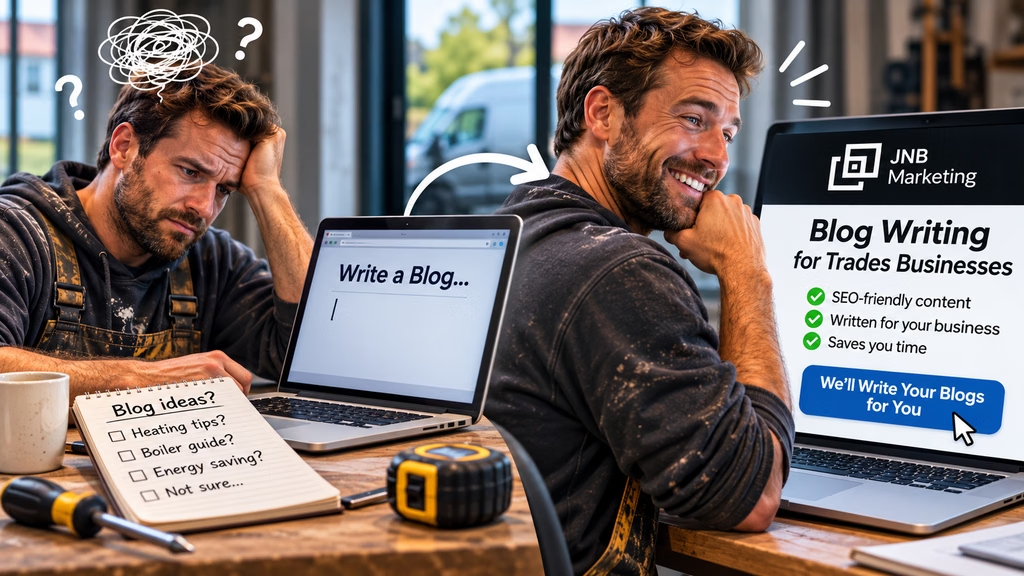
Want Us to Write Your Blog?
Finding useful topics and writing them clearly takes time. Your completed jobs, customer questions and project photos provide a good starting point.
At JNB Marketing, we write blogs and project articles for trades across Bournemouth, Poole, Dorset and the UK as part of our marketing support packages. You send us job photos and details, and we turn them into useful content that reflects your business.
Get in touch to discuss whether blogging would help your website and which topics should come first.
Blogging for Local SEO FAQ
How long until a blog helps my rankings?
There is no fixed timeline. Search engines need to discover your content, and performance depends on the topic, competition and your website. Track relevant traffic, enquiries and booked work over time.
How long should a blog post be?
Long enough to answer the question clearly. Some topics need a short explanation; others need examples and more detail. Avoid adding words just to reach a target length.
Can I use AI to write my blog?
You can use it to help plan and draft articles. Check the facts and add your own experience, project details and local knowledge before publishing. The final article should provide useful, accurate information.
Should I blog about the same topics as competitors?
You can answer the same customer questions, but add your own examples and perspective. Look for information they have missed rather than copying their structure and wording.